WOOD STOCK To main page Write e-mail Русский


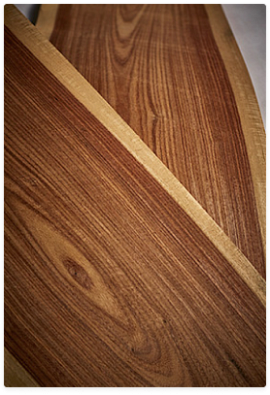
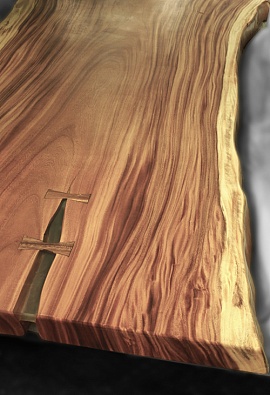
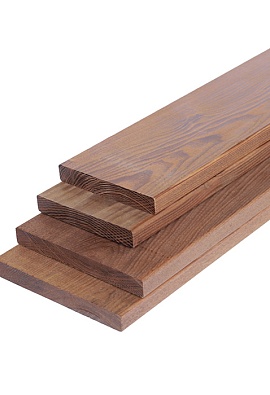
Bubinga pommele

Scientific name: Guibourtia tessmanii
Origin: Africa
Local names: oveng, kevazingo, akume
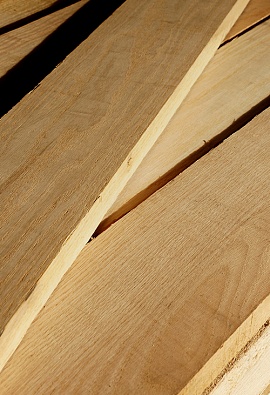
Thickness: 52 mm, square adged lamber, kiln dry


Description: Brown to violet-red heartwood with conspicuous growth zones. Resin pockets can occur; these degrade both the veneer and lumber. To achieve the required grain Bubinga is either true quarter cut (rather plain) or rotary cut eccentrically (colorful). Differentiation is made between plain striped and pommele Bubinga wood, latter of which is considered the most valuable at present.
Mechanical properties: The timber has low steam bending qualities and exudation of gum pockets is troublesome.

Workability: Despite its great hardness this wood is relatively easy to work. There is a moderate to severe blunting effect on cutting edges which must be kept sharp. However, carbide-tipped tools should be used. The wood is suitable for any type of varnish or polish treatment. No special considerations are necessary and glue joints can be easily produced. It is essential to pre-drill screw joints because of the hardness of this wood.

Uses: Higher quality architectural woodwork and mass-produced furniture, paneling and parquet flooring. Well-suited also for musical instruments. It is an excellent turnery wood, and used for knife handles, fancy goods. The chief use is for sliced decorative veneers for cabinets and panelling.

Density: 920 kg/m3 at 12 % moisture content
Monnin hardness: 10.2 (hardness varies from hard to very hard)
Total tangential shrinkage: 7.9 %
Total radial shrinkage: 5.5 %
Stability: poorly stable
Modulus of elasticity: 20180 MPa
Durability: moderately durable.

Bubinga pommele
go to catalogue
About Company   |   Products   |   Species   |   Contacts    
 Copyright 2007 WoodStock. phone: +7 495 617-17-99, fax: +7 495 617-15-99
дизайн сайтов форумов by "RBS Design"    Search engine optimization -